



You've probably heard the term "DEX" thrown around in crypto conversations. Maybe you've seen it on a trading app or read it in a headline. But what exactly is a DEX — and why does it matter?
In this guide, we break down decentralised exchanges in plain English. No jargon, no fluff. By the end, you'll understand what a DEX is, how it works, and why platforms like KindSwap are built on this technology.
Quick answer: A DEX (Decentralised Exchange) lets you trade crypto directly from your own wallet — no company holds your funds, no account required.
What Is a DEX?
A DEX — short for Decentralised Exchange — is a platform that lets you trade cryptocurrencies directly from your own wallet, without handing your funds to a company or middleman.
On a traditional centralised exchange (CEX), you deposit your crypto into the exchange's account. The exchange holds your funds and executes trades on your behalf. You trust them to keep your money safe.
On a DEX, there is no company holding your funds. Trades happen directly between wallets using smart contracts — self-executing code on the blockchain. You stay in control of your assets at all times.
CEX vs DEX: What's the Difference?
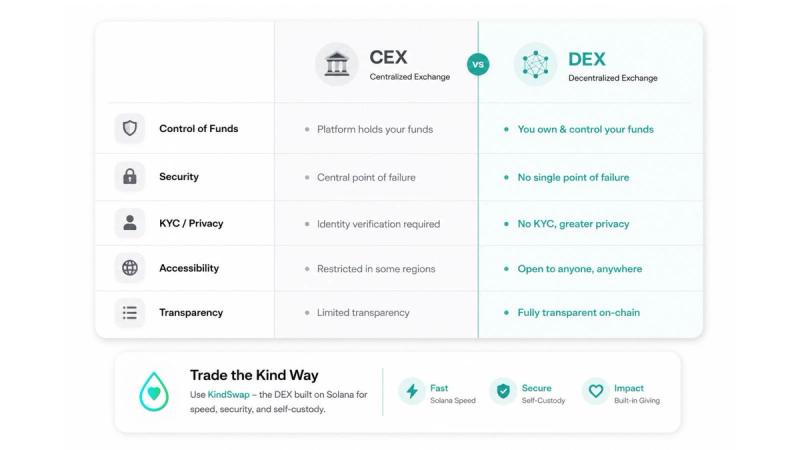
As the image above shows, the key differences are:
- Control of Funds — CEX holds your funds. DEX: you own and control them at all times.
- Security — CEX has a central point of failure. DEX: no single point of failure.
- KYC / Privacy — CEX requires identity verification. DEX: no KYC, greater privacy.
- Accessibility — CEX is restricted in some regions. DEX: open to anyone, anywhere.
- Transparency — CEX has limited transparency. DEX: fully transparent on-chain.
Trade the Kind Way — Use KindSwap, the DEX built on Solana for speed, security, and self-custody.
How Does a DEX Work?
Most DEXs today use one of two core mechanisms: Automated Market Makers (AMMs) or Order Books.
Automated Market Makers (AMMs)
An AMM replaces the traditional buyer-seller order book with a liquidity pool — a smart contract holding two tokens (e.g. SOL and USDC). The price is set by a mathematical formula: x × y = k.
When you buy SOL with USDC, you add USDC to the pool and remove SOL. The ratio shifts, and the price adjusts automatically.
Examples: Uniswap (Ethereum), Raydium (Solana), Orca (Solana).
Order Book DEXs
Some DEXs replicate the traditional order book model entirely on-chain. Buyers post bids, sellers post asks, and trades execute when prices match. Phoenix (Solana) is a leading example.
DEX Aggregators
A DEX aggregator like KindSwap doesn't hold its own liquidity. Instead, it scans multiple DEXs simultaneously and routes your trade through the best combination of pools to get you the lowest price and least slippage.
Think of it like a flight comparison site — instead of checking each airline individually, you get the best deal in one search. That's KindSwap.
What Are Liquidity Pools?
Liquidity pools are the fuel that powers DEXs. They are smart contracts funded by liquidity providers (LPs) — regular users who deposit pairs of tokens (e.g. 50% SOL + 50% USDC) and earn a share of trading fees in return. Without liquidity providers, there would be no pools to trade against. The deeper the pool, the less slippage traders experience.
Why Use a DEX?
- Self-custody — Your keys, your coins. No exchange can freeze or lose your funds.
- Access to new tokens — Trade any token the moment it launches, not just exchange-listed ones.
- No KYC — Trade without submitting ID documents.
- Transparency — Every trade is recorded on the blockchain and publicly verifiable.
- Composability — DEXs integrate with other DeFi protocols — lending, yield farming, and more.
How KindSwap Fits In
KindSwap is a DEX aggregator built on Solana. It routes your swaps across Solana's top liquidity sources to find the best price — and a portion of every trading fee goes to real-world charitable causes you choose. So when you swap on KindSwap, you're not just getting a great price. You're also funding food security, education, healthcare, and more. That's what The Kind Model means.
→ Try KindSwap: kindswap.world
Frequently Asked Questions
Is a DEX safe?
DEXs are generally safer than CEXs for fund custody because you never give up control of your wallet. However, smart contract bugs and scam tokens are real risks. Always use audited platforms and verify token addresses.
Do I need an account to use a DEX?
No. You only need a compatible crypto wallet — like Phantom, Solflare or MetaMask for Solana. Connect your wallet and you're ready to trade.
What is the best DEX on Solana?
For aggregated best prices, KindSwap and Jupiter are the top choices. For deep liquidity pools, KindSwap, Raydium and Orca are leading AMMs.
Conclusion
A DEX gives you the freedom to trade crypto on your own terms — no middlemen, no account required, no custody risk. Whether you're swapping SOL for USDC or exploring new DeFi tokens, a DEX puts you in control.
Ready to try it? Swap on KindSwap and turn your trades into real-world impact.


