



When you trade on a DEX, three separate costs eat into your returns: slippage, price impact, and fees. Most traders know about fees. Far fewer understand slippage and price impact — and the difference between them.
This article breaks down all three clearly, shows you how they interact, and explains how to minimise each one when trading on Solana.
Quick summary: Fees are fixed and predictable. Price impact is caused by your own trade. Slippage is caused by the market moving while your trade executes. All three are separate — and all three affect your final cost.
The Three Costs of DEX Trading
- Fees — fixed % charged by the DEX protocol. Predictable. Partially avoidable by choosing a low-fee DEX.
- Price Impact — your trade moves the market price. Shown before you trade. Partially avoidable by splitting trades or using an aggregator.
- Slippage — price moves between submission and execution. Not predictable. Partially avoidable by setting tolerance and trading on a fast chain.
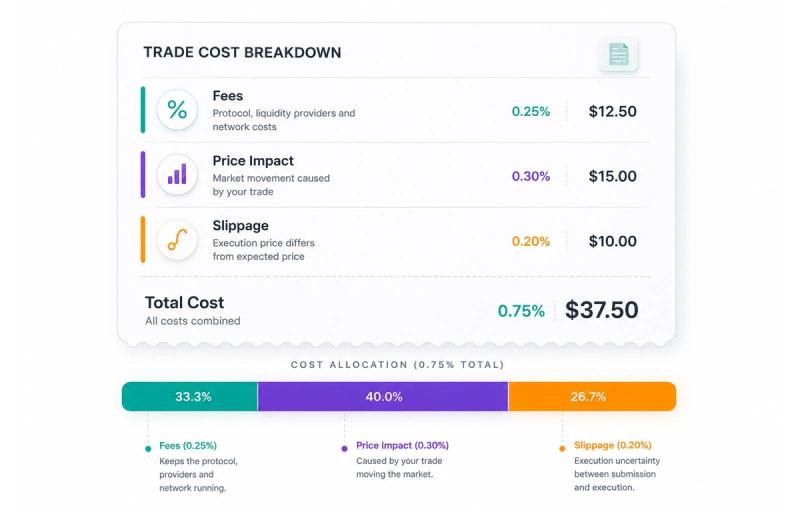
Fees — Protocol, LPs and Network Costs
DEX fees are the simplest of the three. They're a fixed percentage charged on every trade, split between liquidity providers (typically 0.2–0.25%), the protocol treasury (typically 0.05%), and the aggregator fee if using KindSwap (0.1–0.090%).
On Solana, total DEX fees are typically 0.25–0.35% per trade — among the lowest in DeFi. On KindSwap, fees are just 0.1% to 0.090%, and a portion goes to charitable causes through The Kind Model.
On KindSwap, your fees don't just pay for execution — they fund real-world charitable causes. Fees create ecosystem + impact value.
Price Impact — Market Movement Caused by Your Own Trade
Price impact is the effect your trade has on the market price within the liquidity pool. It's caused by the AMM's pricing formula (x × y = k). When you buy SOL from a USDC/SOL pool, you're adding USDC and removing SOL. The pool now has more USDC and less SOL, so the SOL price goes up. The larger your trade relative to the pool, the more you move the price.
Rule of thumb: If price impact is above 1%, consider splitting your trade or using a DEX aggregator to spread it across multiple pools. KindSwap does this automatically.
Slippage — Execution Price Differs From Expected Price
Slippage is different from price impact. While price impact is caused by your own trade, slippage is caused by external market movement between when you submit your transaction and when it's confirmed on-chain. On Solana, with ~400ms confirmation, slippage from market movement is much lower than on Ethereum. The recommended setting on KindSwap is 0.1% for stable pairs and 0.5% for major tokens.
How the Three Costs Add Up:
Here's a real example — swapping $5,000 USDC for SOL: Fees at 0.25% = $12.50. Price impact at 0.30% = $15.00. Slippage at 0.20% = $10.00. Total cost: 0.75% = $37.50. Cost allocation: Fees 33.3% | Price Impact 40.0% | Slippage 26.7%.
Using a DEX aggregator like KindSwap can reduce Price Impact to near zero by splitting the trade across multiple pools — potentially saving $15+ on this single $5,000 swap.
How to Minimise All Three Costs
Minimise Fees
- Use DEXs with competitive fee structures — Solana DEXs are among the cheapest.
- Hold KNS tokens for fee discounts on KindSwap.
- Avoid unnecessary swaps — each trade has a cost.
Minimise Price Impact
- Use a DEX aggregator to split trades across multiple pools automatically.
- Check the price impact % before confirming — aim for under 1%.
- Break large trades into smaller ones over time.
Minimise Slippage
- Trade on Solana — 400ms confirmation dramatically reduces market movement risk.
- Set appropriate slippage tolerance — 0.1% for stable pairs.
- Avoid trading during extreme volatility events.
On KindSwap, all three costs are managed for you: competitive fees (with a portion going to charity), smart aggregation routing minimises price impact, and Solana's speed reduces slippage.
→ Trade smarter, give more: kindswap.world
Frequently Asked Questions
Which is worse: slippage or price impact?
Both cost you money, but price impact is often larger for significant trades. Price impact is predictable and shown before you trade; slippage is unpredictable. A DEX aggregator addresses price impact most effectively.
Does KindSwap show price impact before I trade?
Yes. KindSwap displays the expected output, price impact percentage, and minimum received amount before you confirm any swap.
Are fees included in slippage tolerance?
No. Slippage tolerance only covers price movement. Fees are charged separately and are not included in the slippage calculation.
Conclusion
Fees, price impact, and slippage are three distinct costs that every DEX trader faces. Understanding the difference lets you make smarter decisions: choose the right DEX, set the right slippage tolerance, and use aggregation to minimise price impact. On KindSwap, all three are managed for you — and a portion of your fees funds real-world charitable causes on every single swap.


