



Every crypto trader faces the same question: should I use a centralised exchange (CEX) or a decentralised exchange (DEX)? The answer depends on what you value most — convenience, control, privacy, or access.
In 2026, DEX trading volume has grown to over 13% of total crypto spot volume, up from under 7% in 2024. More traders than ever are making the switch.
Quick answer: CEXs are easier to start with. DEXs give you full control. KindSwap is the DEX that also gives back — every swap funds real-world charitable causes.
What Is a CEX?
A centralised exchange (CEX) is a company-operated platform where you deposit funds, create an account, and trade. Examples include Binance, Coinbase, Kraken, and OKX. The exchange acts as a custodian — it holds your funds and matches your orders. CEXs are fast, user-friendly, and offer deep liquidity. But they require trust: you're trusting the company not to get hacked, go bankrupt, or freeze your account.
What Is a DEX?
A decentralised exchange (DEX) runs on smart contracts on a blockchain. There's no company holding your funds. You connect your wallet, approve a transaction, and the swap executes on-chain. Examples include Uniswap (Ethereum), Raydium (Solana), and KindSwap (Solana).
DEX vs CEX: Full Comparison
- Custody — CEX holds your funds; on a DEX you keep self-custody.
- KYC — CEXs require ID; DEXs require none.
- Account setup — CEX needs email + verification; a DEX just needs a wallet.
- Speed — CEX is millisecond off-chain; KindSwap on Solana settles in ~400ms.
- Fees — CEXs charge 0.1–0.5%; KindSwap charges 0.1–0.090% plus tiny gas.
- Token selection — CEXs list curated tokens only; DEXs trade any token with liquidity.
- Hack risk — CEXs are centralised honeypots; DEXs have no central fund pool.
- Downtime — CEXs have server outages; blockchains run 24/7.
- Charitable impact — CEXs: none. KindSwap: a portion of every fee funds real-world causes.
When to Use a CEX
- You're buying crypto for the first time with fiat (bank transfer or card).
- You need very high liquidity for large institutional trades.
- You want a simple, familiar interface and customer support.
When to Use a DEX
- You already hold crypto and want to swap between tokens.
- You want to trade new or obscure tokens not listed on CEXs.
- You value privacy and don't want to submit KYC documents.
- You want full control of your funds at all times.
- You want your trading activity to contribute to charitable causes (KindSwap).
The Security Question
CEX hacks have cost the industry billions. Mt. Gox, FTX, Bitfinex — the list of catastrophic CEX failures is long. When a CEX is hacked or collapses, users often lose everything. DEXs eliminate this risk for your funds — you never give up custody.
On KindSwap, your funds never leave your wallet until the trade executes. Non-custodial by design.
Fees: Which Is Cheaper?
On Solana, DEX fees are extremely competitive. A swap on KindSwap costs roughly 0.1–0.090% in protocol fees, plus Solana gas of less than $0.001. Compare that to Binance's 0.1% maker/taker fee — DEXs on Solana are often cheaper, especially for smaller trades.
KindSwap vs a Typical DEX
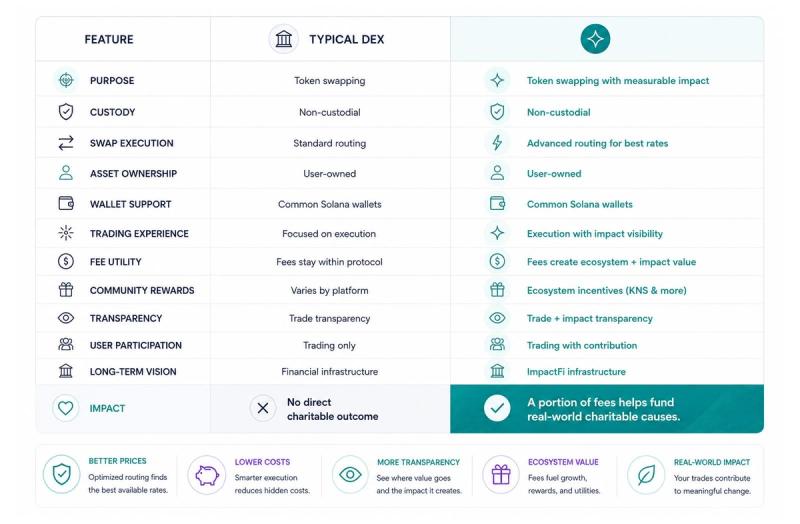
- Better Prices — optimised routing finds the best available rates.
- Lower Costs — smarter execution reduces hidden costs.
- More Transparency — see exactly where your value goes.
- Ecosystem Value — fees fuel growth, rewards, and utilities.
- Real-World Impact — your trades contribute to meaningful charitable change.
KindSwap is the only DEX where every swap gets you the best price AND funds real-world charitable causes. That's The Kind Model in action.
→ Try KindSwap: kindswap.world
Frequently Asked Questions
Can I use both a CEX and a DEX?
Absolutely. Many traders use a CEX to buy crypto with fiat, then move funds to a self-custody wallet and trade on DEXs. This combines the convenience of fiat on-ramps with the freedom of decentralised trading.
Is a DEX legal?
Yes. DEXs are permissionless protocols — using them is legal in most jurisdictions. However, trading certain tokens may have regulatory implications depending on your country.
Conclusion
CEXs and DEXs serve different needs. In 2026, the smartest traders use both — and the best DEX traders on Solana are choosing KindSwap. Not just for the best prices, but because every swap funds food security, education, healthcare, and more through The Kind Model.


